

When you want something different from a traditional country loaf this Easy Homemade Pumpkin Sourdough Bread offers a cozy twist. This pumpkin sourdough recipe is soft and simple and packed with warm flavor. It’s perfect for slow breakfasts or holiday gatherings. The crust bakes dark and crackly while the crumb stays tender and lightly orange. And the pumpkin shape makes the loaf feel special without complicated decorating.
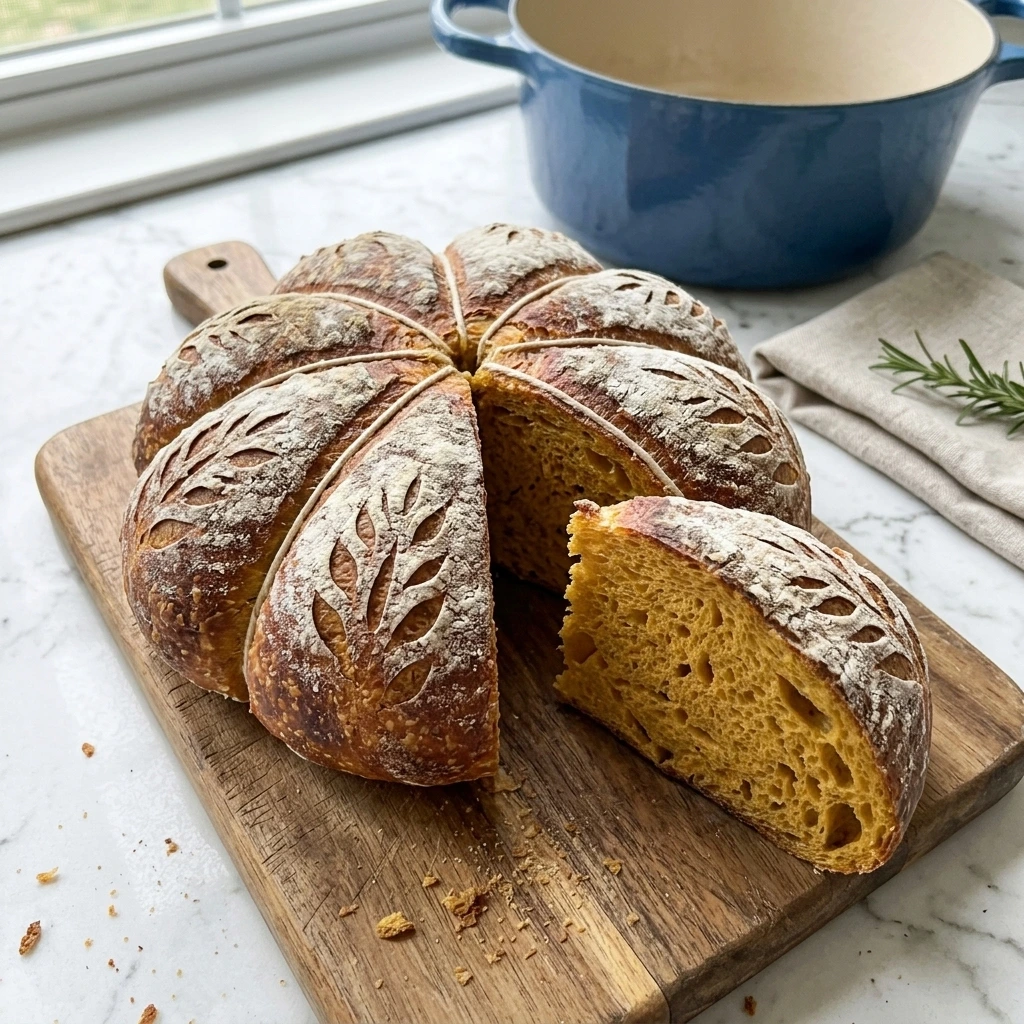
This recipe is perfect for Thanksgiving brunch and Christmas morning and a Friendsgiving meal or weekend meal prep. The dough gets its color from thick pumpkin puree and its gentle tang from an active starter. If you want another homemade breakfast treat then check out these Homemade Cinnamon Rolls. Both recipes reward a little patience and fill the kitchen with a warm bakery smell. You don’t need advanced bread skills for this loaf.
You’ll mix the dough and build strength with four simple folds and then let the refrigerator handle the long proof. The twine creates those rustic pumpkin segments and the leaf scoring adds the final touch. But the best part comes after slicing. The crumb is soft enough for toast and sturdy enough for sandwiches and it stays pleasantly moist for several days.
Ingredients

Here’s what I use for this recipe and you can always make substitutions if you prefer.
- sourdough starter: Fed and used at peak activity so it can lift the pumpkin-rich dough.
- water: Warmed to 78°F and added gradually when the pumpkin puree seems loose.
- 100% pumpkin puree: Use thick canned puree and avoid sweetened pumpkin pie filling.
- pure maple syrup: Adds mild sweetness and helps the crust deepen in color.
- unbleached bread flour: Provides strong gluten for height and a pleasantly chewy crumb.
- whole wheat flour: Adds a nutty flavor and supports active fermentation.
- fine sea salt: Strengthens the dough and balances the pumpkin and maple flavors.
- ground cinnamon: Brings the main warm spice note without overpowering the sourdough.
- ground ginger: Adds a gentle peppery warmth to the orange crumb.
- ground nutmeg: Rounds out the pumpkin flavor with a sweet woody note.
- ground cloves: Use a small amount because its flavor becomes strong during baking.
- white rice flour: Dusts the proofing basket and loaf surface without turning sticky.
Tools You’ll Need
- 5-quart cast-iron Dutch oven: A heavy 5-quart cast-iron Dutch oven traps steam and drives oven spring while a thin pot loses heat and can leave the loaf pale.
- Large clear glass mixing bowl: A 4-quart clear bowl shows fermentation growth and gives the dough room to expand while a smaller bowl makes rise estimates unreliable.
- Flexible silicone spatula: A broad flexible spatula folds the sticky dough without tearing it while a rigid spoon leaves dry flour trapped along the bowl wall.
- Digital kitchen scale: A scale measuring to 1 gram keeps hydration accurate because cup measurements can add enough flour or water to change the dough.
- Round 9-inch proofing basket: A 9-inch round basket supports the boule during its cold proof while a wide basket encourages the dough to spread.
- Food-safe cotton twine: Four 30-inch cotton strands form the pumpkin lobes and synthetic string can melt or leave unsafe residue at high heat.
- Parchment paper: A heat-safe parchment sheet lowers the scored loaf into the pot and weak paper can scorch or tear under a heavy dough.
- Instant-read thermometer: A fast thermometer confirms the center reaches 208°F to 210°F and prevents guessing from crust color alone.
- Serrated bread knife: A sharp 9-inch serrated knife cuts the cooled crust cleanly while a dull short blade compresses the tender crumb.
Instructions
Step 1: Mix and rest the pumpkin dough
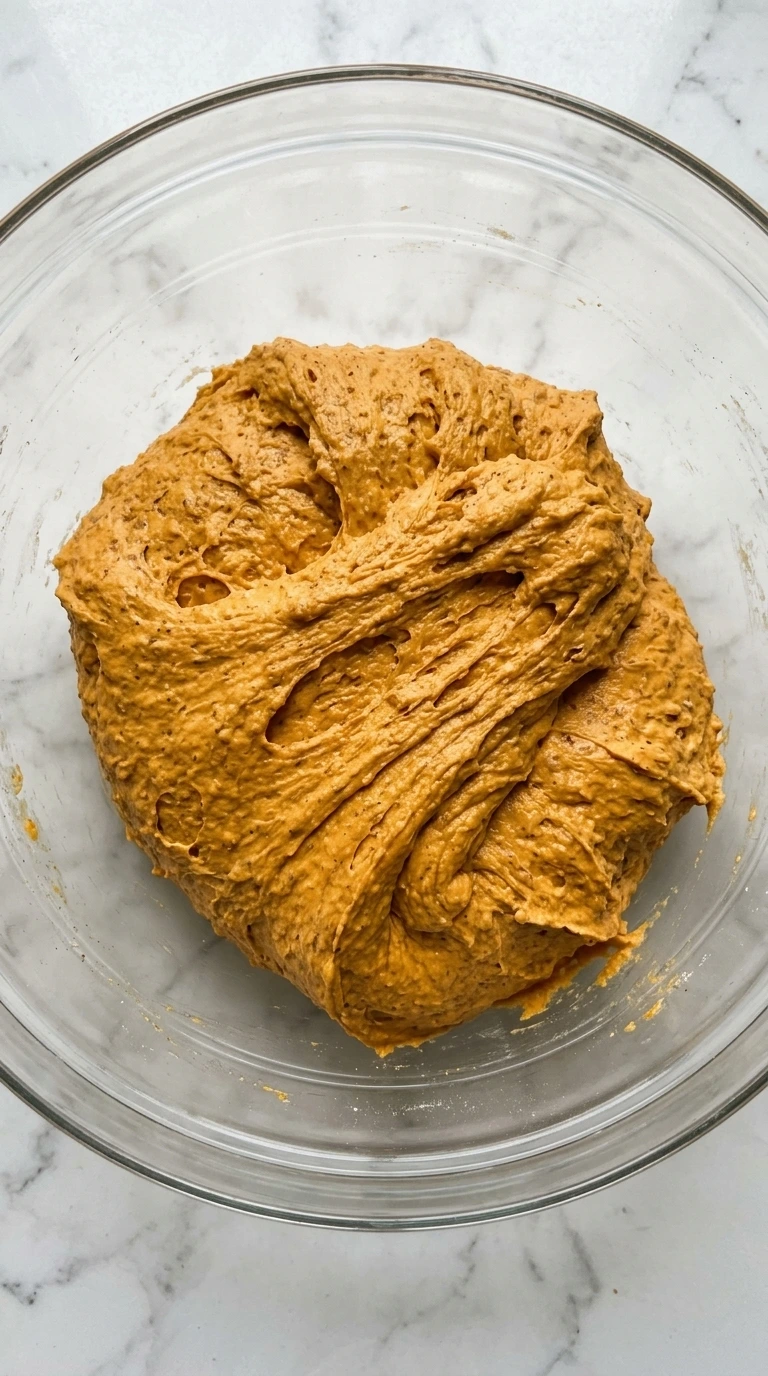
Warm 230 grams of water to 78°F. Stir in active sourdough starter and pure maple syrup for 30 seconds until cloudy. Add pumpkin puree and whisk for another 30 seconds. Then fold in unbleached bread flour and whole wheat flour with a rubber spatula.
Rotate the bowl after each fold. Cover and rest the shaggy orange dough for 30 minutes at 76°F. Next add fine sea salt and ground cinnamon and ground ginger and ground nutmeg and ground cloves. Pinch the dough between wet fingers for 2 minutes and fold it over itself 12 times.
The dough should look evenly orange with no dry flour pockets. It will feel sticky but cohesive and smell lightly spiced. Stop after 2 minutes or the gluten can tear. The short rest hydrates flour before strong gluten development.
Tip: Keep 15 grams of the measured water aside when your pumpkin puree looks loose and add it only if needed.
Step 2: Fold and bulk ferment the dough

Keep the dough at 76°F to 78°F for 4 to 6 hours. During the first 2 hours perform four stretch-and-fold sets every 30 minutes. Lift one edge until it resists and fold it across the center. Turn the bowl a quarter turn and repeat four times.
Then leave the dough untouched for the remaining bulk rise. The dough should gain about 60 percent in volume and show rounded bubbles along the sides. Its surface will look smoother and slightly domed. A gentle shake should make it wobble without collapsing.
(I once waited for a full doubling and the loaf spread flat. Sixty percent is the better target. ) Go past 6 hours and the gluten may weaken. Controlled warmth balances fermentation and dough strength.
Tip: Mark the starting dough height with a removable band so a 60 percent rise is easier to judge.
Step 3: Shape and cold proof the boule
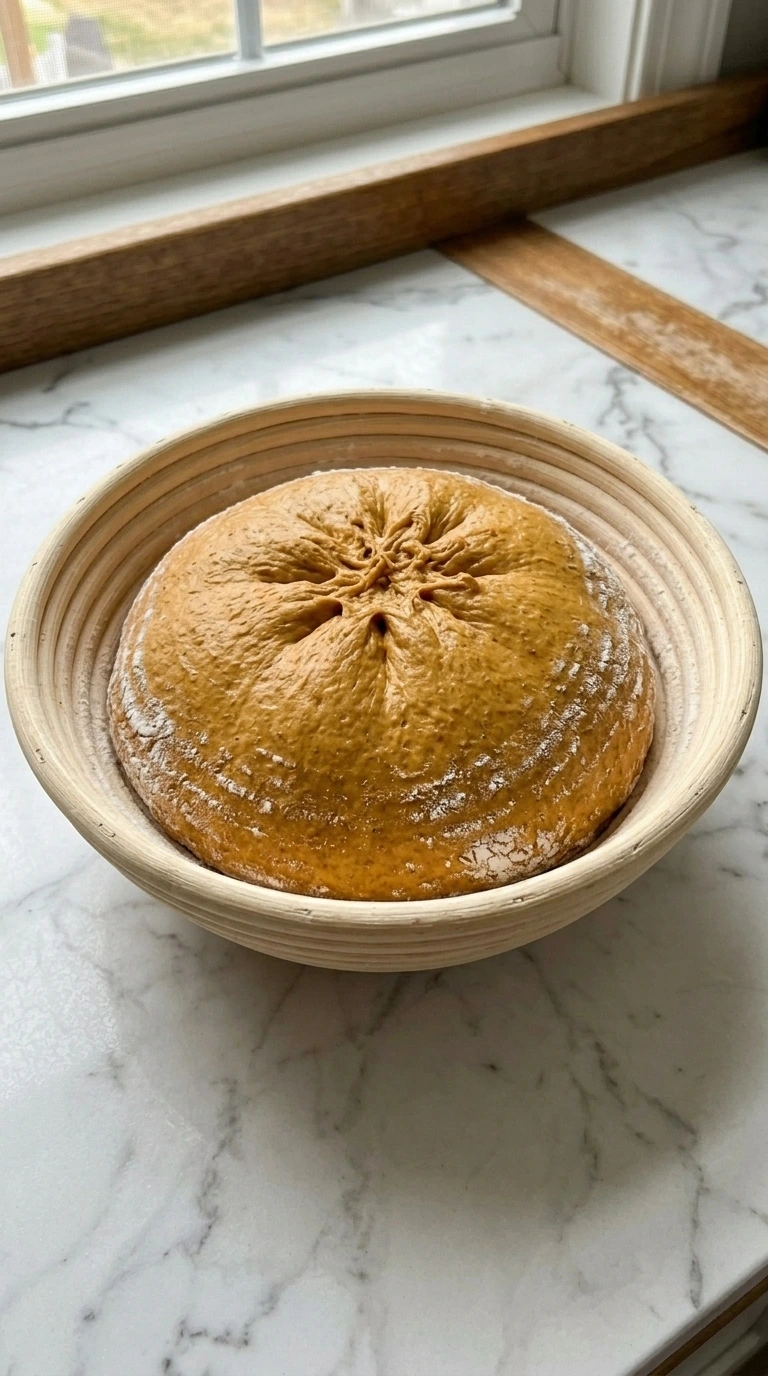
Turn the dough onto a lightly damp surface after bulk fermentation. Fold the edges toward the center for 1 minute and flip it seam-side down. Drag the round toward you six times to tighten the skin. Let it rest uncovered for 20 minutes at 72°F.
Then repeat the tightening motion until the boule holds a round eight-inch shape. Dust a round proofing basket with white rice flour and place the boule seam-side up. Cover and refrigerate at 38°F to 40°F for 8 to 12 hours. The chilled dough should feel firm and show a slight rise without large blisters.
Skip the tight shaping and the loaf spreads sideways. Cold proofing firms the surface for clean scoring.
Tip: Use white rice flour in the proofing basket because it absorbs less moisture and releases sticky dough more cleanly.
Step 4: Tie and score the pumpkin shape

During the final 45 minutes of the cold proof preheat the oven and 5-quart Dutch oven to 475°F. Turn the cold boule onto parchment after the 8 to 12 hour proof. Lay four 30-inch lengths of food-safe cotton twine across the center at even angles. Set the boule in the middle and tie each strand loosely over the top.
Leave about one-quarter inch of slack. Dust the surface with white rice flour and score leaf shapes about one-quarter inch deep. The dough should show eight uneven segments and crisp pale score lines. Keep it near 40°F and finish within 5 minutes.
Warm dough sticks to the twine and loses definition. Don’t pull the knots tight or they can cut through the expanding crust. Loose twine guides expansion without strangling the loaf.
Tip: Tie the final knot where one score line will open so the small mark disappears into the baked crust.
Step 5: Bake until deeply browned

Lower the tied loaf into a preheated 5-quart Dutch oven at 475°F. Cover and bake for 20 minutes. Then remove the lid and lower the oven to 450°F. Bake another 25 to 30 minutes.
Rotate the pot once at minute 15 of the uncovered bake. Stop when the center reaches 208°F to 210°F. The crust should turn dark golden brown with amber cracks between flour-dusted lobes. You’ll hear a hollow thump near the base and smell toasted pumpkin spice.
If the crust darkens before 208°F then tent it loosely for the final 5 minutes. Underbaking leaves a gummy band inside. High covered heat traps steam and builds oven spring.
Tip: Slip a small baking sheet onto the rack below the Dutch oven if your oven tends to darken loaf bottoms.
Step 6: Cool and slice the center
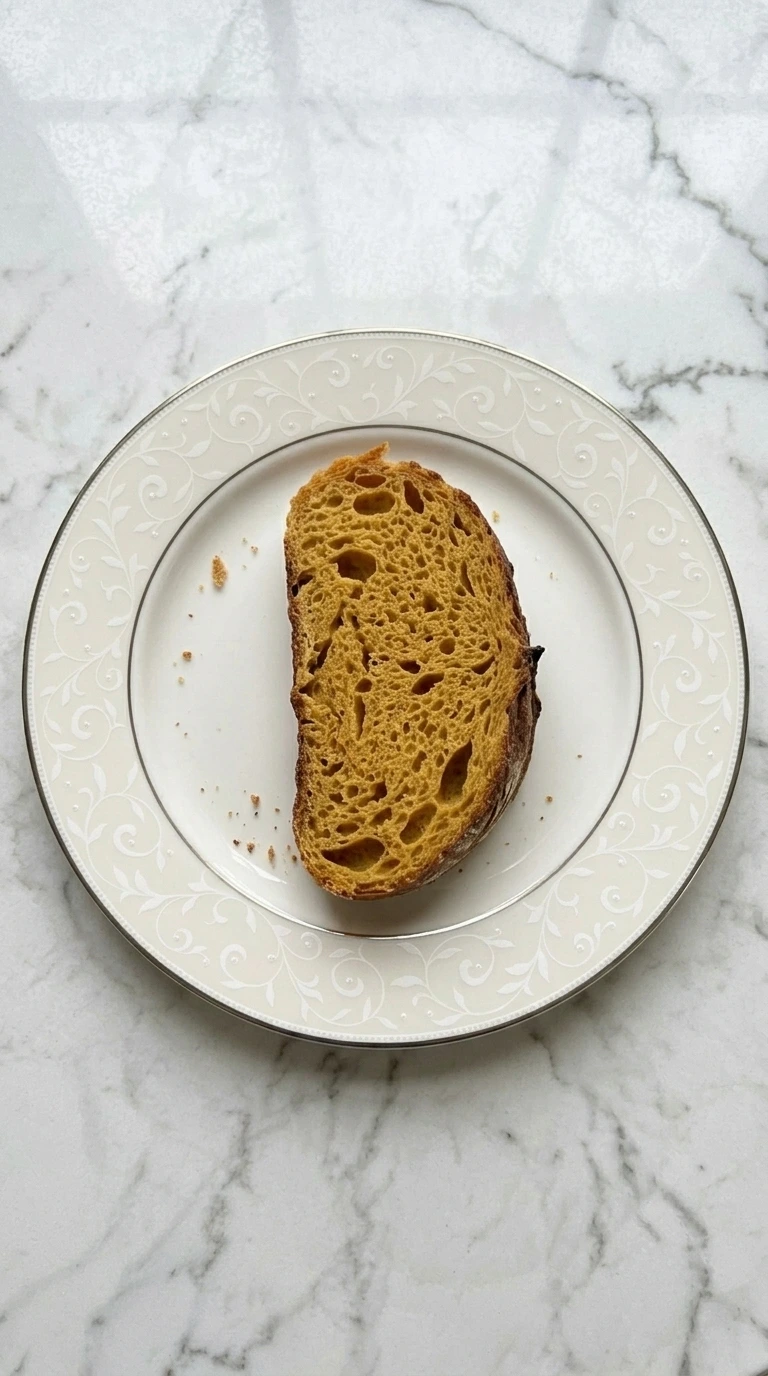
Move the loaf out of the Dutch oven and cut away the twine after 10 minutes. Cool it for at least 2 hours at 70°F before slicing. Use a gentle sawing motion and cut one three-quarter-inch slice from the center.
Place that slice on a white plate while the remaining loaf stays intact for later storage. The crumb should look softly orange with irregular medium holes and no wet streaks. The crust will crackle as it cools and feel crisp under your fingers.
Slice before 2 hours and trapped steam can compress the crumb. (I used to cut at 30 minutes and every center looked gummy. ) Full cooling lets starches set before the knife passes through.
Tip: Freeze half the loaf in three-quarter-inch slices on baking day so later portions taste fresher after toasting.
Pro Tips
- Use a starter that doubles within 4 to 6 hours after feeding because weak starter can’t lift this moist dough.
- Weigh the pumpkin puree at 180 grams and hold back 15 grams of water if the puree looks loose or glossy.
- Keep bulk fermentation near 76°F because every 5°F increase can shorten the rise and push the dough past its strongest point.
- Stop bulk fermentation at about 60 percent growth and look for rounded side bubbles instead of waiting for a full doubling.
- Leave one-quarter inch of slack in each twine loop so the loaf can expand without the cotton cutting into the crust.
- Preheat the 5-quart Dutch oven for 45 minutes at 475°F so the base delivers strong oven spring instead of a pale bottom.
- Cool the loaf for a full 2 hours and listen for crust crackling before slicing because the center is still setting.
- Fold in 90 grams of toasted chopped pecans during the second fold for a nutty loaf with extra crunch.
- Add 75 grams of dried cranberries during the third fold for tart pockets that suit a Thanksgiving brunch.
- Replace the ground cloves with 1 teaspoon of finely chopped fresh rosemary for a savory pumpkin loaf.
- Fold in 100 grams of sharp cheddar and 1 tablespoon of chopped fresh sage during the final fold for a richer sandwich bread.
Storage Instructions
Keep the fully cooled loaf in a paper bag inside a bread box for 2 days. For longer storage place slices in an airtight container and refrigerate for up to 5 days. Freeze individual slices between parchment sheets and seal them in a freezer bag for 3 months. Press out extra air before closing.
Thawed slices work especially well in an Egg and Cheese Breakfast Sandwich. Reheat one slice at 350°F for 6 to 8 minutes or toast it from frozen for 4 to 5 minutes. Mist a refrigerated slice with 1 teaspoon of water before oven reheating. That small amount restores surface moisture without making the crumb soggy.
Discard the loaf if you see fuzzy spots or smell sharp fermentation. A leathery crust alone means staling and not spoilage.
Print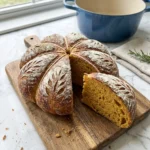
Easy Homemade Pumpkin Sourdough Bread
- Total Time: 16 hours 30 minutes
- Yield: 10 slices servings 1x
Description
This easy pumpkin sourdough bread brings quick fall baking ideas to any brunch, holiday table or meal prep plan. The simple dough bakes into the best healthy-leaning loaf with a crackly amber crust and a soft orange crumb that smells like warm pumpkin spice. What makes this version different is the trick of using thick pumpkin puree while holding back extra water, so the loaf stays light instead of gummy. Print it for a party, potluck or cozy weekend breakfast.
Ingredients
- 100 grams sourdough starter
- 230 grams water
- 180 grams 100% pumpkin puree
- 20 grams pure maple syrup
- 450 grams unbleached bread flour
- 50 grams whole wheat flour
- 10 grams fine sea salt
- 1 1/2 teaspoons ground cinnamon
- 1/2 teaspoon ground ginger
- 1/4 teaspoon ground nutmeg
- 1/8 teaspoon ground cloves
- 2 tablespoons white rice flour
Instructions
- Warm 230 grams of water to 78°F. Stir in active sourdough starter and pure maple syrup for 30 seconds until cloudy. Add pumpkin puree and whisk for another 30 seconds. Then fold in unbleached bread flour and whole wheat flour with a rubber spatula. Rotate the bowl after each fold. Cover and rest the shaggy orange dough for 30 minutes at 76°F. Next add fine sea salt and ground cinnamon and ground ginger and ground nutmeg and ground cloves. Pinch the dough between wet fingers for 2 minutes and fold it over itself 12 times. The dough should look evenly orange with no dry flour pockets. It will feel sticky but cohesive and smell lightly spiced. Stop after 2 minutes or the gluten can tear. The short rest hydrates flour before strong gluten development.
- Keep the dough at 76°F to 78°F for 4 to 6 hours. During the first 2 hours perform four stretch-and-fold sets every 30 minutes. Lift one edge until it resists and fold it across the center. Turn the bowl a quarter turn and repeat four times. Then leave the dough untouched for the remaining bulk rise. The dough should gain about 60 percent in volume and show rounded bubbles along the sides. Its surface will look smoother and slightly domed. A gentle shake should make it wobble without collapsing. (I once waited for a full doubling and the loaf spread flat. Sixty percent is the better target.) Go past 6 hours and the gluten may weaken. Controlled warmth balances fermentation and dough strength.
- Turn the dough onto a lightly damp surface after bulk fermentation. Fold the edges toward the center for 1 minute and flip it seam-side down. Drag the round toward you six times to tighten the skin. Let it rest uncovered for 20 minutes at 72°F. Then repeat the tightening motion until the boule holds a round eight-inch shape. Dust a round proofing basket with white rice flour and place the boule seam-side up. Cover and refrigerate at 38°F to 40°F for 8 to 12 hours. The chilled dough should feel firm and show a slight rise without large blisters. Skip the tight shaping and the loaf spreads sideways. Cold proofing firms the surface for clean scoring.
- During the final 45 minutes of the cold proof preheat the oven and 5-quart Dutch oven to 475°F. Turn the cold boule onto parchment after the 8 to 12 hour proof. Lay four 30-inch lengths of food-safe cotton twine across the center at even angles. Set the boule in the middle and tie each strand loosely over the top. Leave about one-quarter inch of slack. Dust the surface with white rice flour and score leaf shapes about one-quarter inch deep. The dough should show eight uneven segments and crisp pale score lines. Keep it near 40°F and finish within 5 minutes. Warm dough sticks to the twine and loses definition. Don’t pull the knots tight or they can cut through the expanding crust. Loose twine guides expansion without strangling the loaf.
- Lower the tied loaf into a preheated 5-quart Dutch oven at 475°F. Cover and bake for 20 minutes. Then remove the lid and lower the oven to 450°F. Bake another 25 to 30 minutes. Rotate the pot once at minute 15 of the uncovered bake. Stop when the center reaches 208°F to 210°F. The crust should turn dark golden brown with amber cracks between flour-dusted lobes. You’ll hear a hollow thump near the base and smell toasted pumpkin spice. If the crust darkens before 208°F then tent it loosely for the final 5 minutes. Underbaking leaves a gummy band inside. High covered heat traps steam and builds oven spring.
- Move the loaf out of the Dutch oven and cut away the twine after 10 minutes. Cool it for at least 2 hours at 70°F before slicing. Use a gentle sawing motion and cut one three-quarter-inch slice from the center. Place that slice on a white plate while the remaining loaf stays intact for later storage. The crumb should look softly orange with irregular medium holes and no wet streaks. The crust will crackle as it cools and feel crisp under your fingers. Slice before 2 hours and trapped steam can compress the crumb. (I used to cut at 30 minutes and every center looked gummy.) Full cooling lets starches set before the knife passes through.
Notes
Pro Tips:
- Use a starter that doubles within 4 to 6 hours after feeding because weak starter can’t lift this moist dough.
- Weigh the pumpkin puree at 180 grams and hold back 15 grams of water if the puree looks loose or glossy.
- Keep bulk fermentation near 76°F because every 5°F increase can shorten the rise and push the dough past its strongest point.
- Stop bulk fermentation at about 60 percent growth and look for rounded side bubbles instead of waiting for a full doubling.
- Leave one-quarter inch of slack in each twine loop so the loaf can expand without the cotton cutting into the crust.
- Preheat the 5-quart Dutch oven for 45 minutes at 475°F so the base delivers strong oven spring instead of a pale bottom.
- Cool the loaf for a full 2 hours and listen for crust crackling before slicing because the center is still setting.
Storage: Keep the fully cooled loaf in a paper bag inside a bread box for 2 days. For longer storage place slices in an airtight container and refrigerate for up to 5 days. Freeze individual slices between parchment sheets and seal them in a freezer bag for 3 months. Press out extra air before closing. Thawed slices work especially well in an Egg and Cheese Breakfast Sandwich. Reheat one slice at 350°F for 6 to 8 minutes or toast it from frozen for 4 to 5 minutes. Mist a refrigerated slice with 1 teaspoon of water before oven reheating. That small amount restores surface moisture without making the crumb soggy. Discard the loaf if you see fuzzy spots or smell sharp fermentation. A leathery crust alone means staling and not spoilage.
- Prep Time: 45 minutes
- Cook Time: 50 minutes
- Category: Breakfast
- Cuisine: American
Nutrition
- Serving Size: 1 serving
Frequently Asked Questions
Yes. Shape the dough after bulk fermentation and refrigerate it at 38°F to 40°F for 8 to 12 hours. You can extend that proof to 16 hours if the starter wasn’t overly active. Beyond 18 hours the dough may weaken and bake flatter.
The dough likely overproofed or the pumpkin puree carried extra water. End bulk fermentation when volume rises about 60 percent and bubbles appear along the bowl. If the dough still feels loose then reduce the water by 15 grams next time and shape with six firm drags.
Yes but drain it in a fine sieve for 30 minutes before weighing 180 grams. Homemade puree often contains more water than canned puree. Hold back 20 grams of the recipe water and add it only if the dough feels firm after mixing.
You can double the dough but divide it into two equal loaves before shaping. Bake each loaf separately in a 5-quart Dutch oven at 475°F covered for 20 minutes. Then finish at 450°F for 25 to 30 minutes so both centers reach 208°F to 210°F.
Serve warm slices with salted butter and apple butter for brunch. For a savory option add sharp cheddar and sliced turkey after toasting each slice for 3 to 4 minutes. The mild pumpkin flavor also pairs well with eggs and creamy soups.
Freeze fully cooled three-quarter-inch slices in one layer for 1 hour and then transfer them to a sealed bag. Keep them frozen for up to 3 months. Toast from frozen for 4 to 5 minutes or bake at 350°F for 8 minutes.
Final Thoughts
So there you go, a pumpkin sourdough loaf that’s simple enough for a quiet weekend but good enough for a gathering. I’ve made this through several chilly mornings and the crackly crust never disappoints.
Save this one and share it with a friend. Then use a few slices for a Classic Turkey Club Sandwich or serve them beside Mini Grilled Cheese Sliders and tell me what fun changes you made.