Description
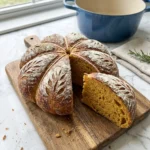
This easy pumpkin sourdough bread brings quick fall baking ideas to any brunch, holiday table or meal prep plan. The simple dough bakes into the best healthy-leaning loaf with a crackly amber crust and a soft orange crumb that smells like warm pumpkin spice. What makes this version different is the trick of using thick pumpkin puree while holding back extra water, so the loaf stays light instead of gummy. Print it for a party, potluck or cozy weekend breakfast.
Ingredients
- 100 grams sourdough starter
- 230 grams water
- 180 grams 100% pumpkin puree
- 20 grams pure maple syrup
- 450 grams unbleached bread flour
- 50 grams whole wheat flour
- 10 grams fine sea salt
- 1 1/2 teaspoons ground cinnamon
- 1/2 teaspoon ground ginger
- 1/4 teaspoon ground nutmeg
- 1/8 teaspoon ground cloves
- 2 tablespoons white rice flour
Instructions
- Warm 230 grams of water to 78°F. Stir in active sourdough starter and pure maple syrup for 30 seconds until cloudy. Add pumpkin puree and whisk for another 30 seconds. Then fold in unbleached bread flour and whole wheat flour with a rubber spatula. Rotate the bowl after each fold. Cover and rest the shaggy orange dough for 30 minutes at 76°F. Next add fine sea salt and ground cinnamon and ground ginger and ground nutmeg and ground cloves. Pinch the dough between wet fingers for 2 minutes and fold it over itself 12 times. The dough should look evenly orange with no dry flour pockets. It will feel sticky but cohesive and smell lightly spiced. Stop after 2 minutes or the gluten can tear. The short rest hydrates flour before strong gluten development.
- Keep the dough at 76°F to 78°F for 4 to 6 hours. During the first 2 hours perform four stretch-and-fold sets every 30 minutes. Lift one edge until it resists and fold it across the center. Turn the bowl a quarter turn and repeat four times. Then leave the dough untouched for the remaining bulk rise. The dough should gain about 60 percent in volume and show rounded bubbles along the sides. Its surface will look smoother and slightly domed. A gentle shake should make it wobble without collapsing. (I once waited for a full doubling and the loaf spread flat. Sixty percent is the better target.) Go past 6 hours and the gluten may weaken. Controlled warmth balances fermentation and dough strength.
- Turn the dough onto a lightly damp surface after bulk fermentation. Fold the edges toward the center for 1 minute and flip it seam-side down. Drag the round toward you six times to tighten the skin. Let it rest uncovered for 20 minutes at 72°F. Then repeat the tightening motion until the boule holds a round eight-inch shape. Dust a round proofing basket with white rice flour and place the boule seam-side up. Cover and refrigerate at 38°F to 40°F for 8 to 12 hours. The chilled dough should feel firm and show a slight rise without large blisters. Skip the tight shaping and the loaf spreads sideways. Cold proofing firms the surface for clean scoring.
- During the final 45 minutes of the cold proof preheat the oven and 5-quart Dutch oven to 475°F. Turn the cold boule onto parchment after the 8 to 12 hour proof. Lay four 30-inch lengths of food-safe cotton twine across the center at even angles. Set the boule in the middle and tie each strand loosely over the top. Leave about one-quarter inch of slack. Dust the surface with white rice flour and score leaf shapes about one-quarter inch deep. The dough should show eight uneven segments and crisp pale score lines. Keep it near 40°F and finish within 5 minutes. Warm dough sticks to the twine and loses definition. Don’t pull the knots tight or they can cut through the expanding crust. Loose twine guides expansion without strangling the loaf.
- Lower the tied loaf into a preheated 5-quart Dutch oven at 475°F. Cover and bake for 20 minutes. Then remove the lid and lower the oven to 450°F. Bake another 25 to 30 minutes. Rotate the pot once at minute 15 of the uncovered bake. Stop when the center reaches 208°F to 210°F. The crust should turn dark golden brown with amber cracks between flour-dusted lobes. You’ll hear a hollow thump near the base and smell toasted pumpkin spice. If the crust darkens before 208°F then tent it loosely for the final 5 minutes. Underbaking leaves a gummy band inside. High covered heat traps steam and builds oven spring.
- Move the loaf out of the Dutch oven and cut away the twine after 10 minutes. Cool it for at least 2 hours at 70°F before slicing. Use a gentle sawing motion and cut one three-quarter-inch slice from the center. Place that slice on a white plate while the remaining loaf stays intact for later storage. The crumb should look softly orange with irregular medium holes and no wet streaks. The crust will crackle as it cools and feel crisp under your fingers. Slice before 2 hours and trapped steam can compress the crumb. (I used to cut at 30 minutes and every center looked gummy.) Full cooling lets starches set before the knife passes through.
Notes
Pro Tips:
- Use a starter that doubles within 4 to 6 hours after feeding because weak starter can’t lift this moist dough.
- Weigh the pumpkin puree at 180 grams and hold back 15 grams of water if the puree looks loose or glossy.
- Keep bulk fermentation near 76°F because every 5°F increase can shorten the rise and push the dough past its strongest point.
- Stop bulk fermentation at about 60 percent growth and look for rounded side bubbles instead of waiting for a full doubling.
- Leave one-quarter inch of slack in each twine loop so the loaf can expand without the cotton cutting into the crust.
- Preheat the 5-quart Dutch oven for 45 minutes at 475°F so the base delivers strong oven spring instead of a pale bottom.
- Cool the loaf for a full 2 hours and listen for crust crackling before slicing because the center is still setting.
Storage: Keep the fully cooled loaf in a paper bag inside a bread box for 2 days. For longer storage place slices in an airtight container and refrigerate for up to 5 days. Freeze individual slices between parchment sheets and seal them in a freezer bag for 3 months. Press out extra air before closing. Thawed slices work especially well in an Egg and Cheese Breakfast Sandwich. Reheat one slice at 350°F for 6 to 8 minutes or toast it from frozen for 4 to 5 minutes. Mist a refrigerated slice with 1 teaspoon of water before oven reheating. That small amount restores surface moisture without making the crumb soggy. Discard the loaf if you see fuzzy spots or smell sharp fermentation. A leathery crust alone means staling and not spoilage.
- Prep Time: 45 minutes
- Cook Time: 50 minutes
- Category: Breakfast
- Cuisine: American
Nutrition
- Serving Size: 1 serving