

This Patty Pan Squash Frittata recipe is an easy, comforting breakfast that comes together so quickly in one skillet! With tender squash that isn’t soggy, soft eggs and golden pockets of sharp cheddar.
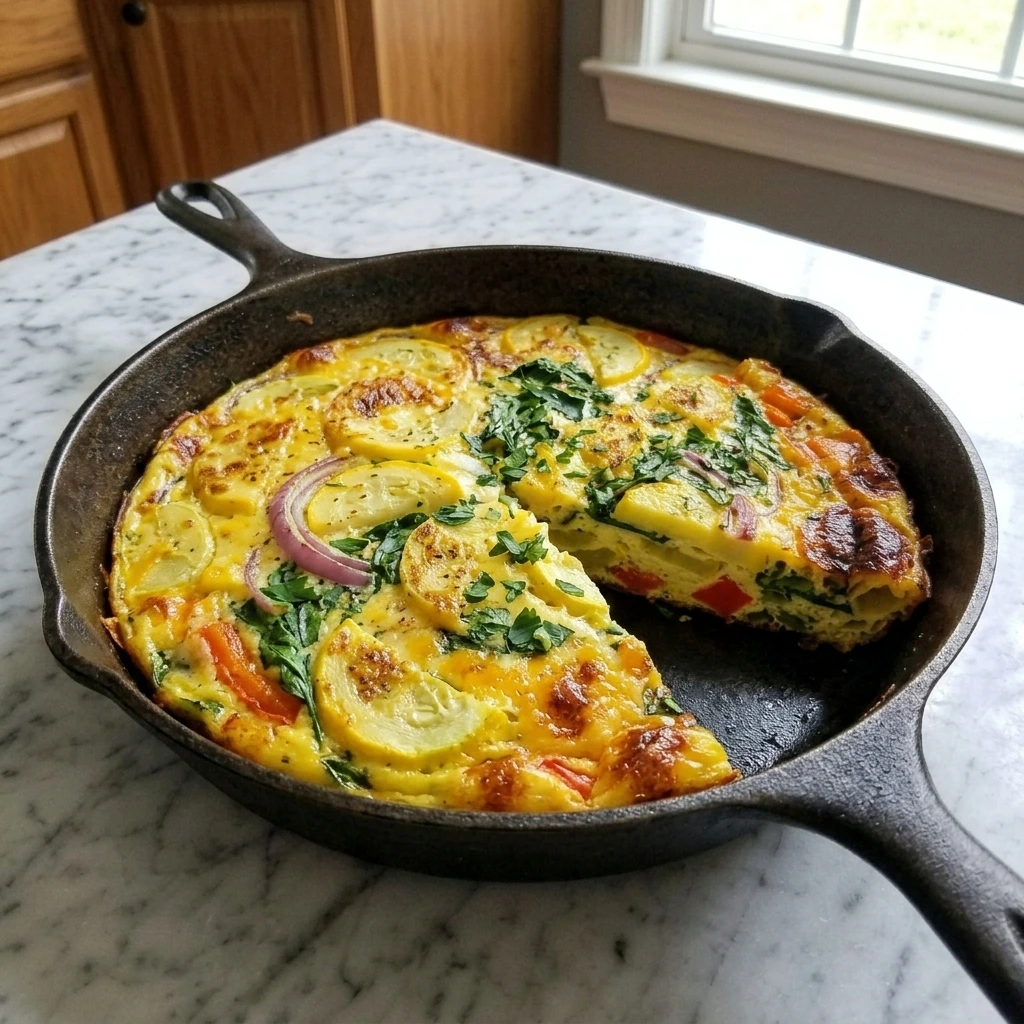
We love summer because it means that simple meals like this frittata and our Egg and Cheese Breakfast Sandwich are back on the table. Comfort foods, especially those that are healthy and nourish our bodies, are my favorite kinds of meals.
Ingredients

Here’s what I use for this recipe and you can always make substitutions if you prefer.
- Yellow patty pan squash: Trimmed and cut into irregular 1/4-inch half-moons so the scalloped shape remains visible.
- Red bell pepper: Seeded and cut into uneven 1/2-inch pieces for sweetness and bright color.
- Red onion: Thinly sliced into curved pieces that soften without disappearing.
- Garlic: Finely minced so it perfumes the vegetables during the final minute.
- Baby spinach: Left whole and wilted briefly to add dark green pockets without excess moisture.
- Fresh thyme leaves: Stripped from the stems to season the squash with a warm herbal flavor.
- Flat-leaf parsley: Roughly chopped and scattered over the rested slices for a fresh finish.
- Large eggs: Held at room temperature for 10 minutes before whisking for a smoother mixture.
- Whole milk: Added to soften the egg curd without making the center loose.
- Sharp cheddar cheese: Freshly grated and divided between the egg mixture and the top.
- Extra-virgin olive oil: Used to sauté the vegetables and encourage light golden patches.
- Kosher salt: Divided between the vegetables and eggs for even seasoning.
- Ground black pepper: Whisked into the eggs for gentle heat and visible specks.
Tools You’ll Need
- 10-inch cast-iron skillet: A well-seasoned 10-inch oven-safe skillet browns the vegetables and bakes the eggs evenly, while a larger pan makes the frittata thin and dry.
- Large clear glass mixing bowl: A 3-quart bowl leaves enough room to whisk without splashing, while a narrow bowl traps unmixed egg near the bottom.
- Balloon whisk: A medium stainless steel balloon whisk blends the eggs in under 1 minute, while a tiny whisk encourages excessive beating.
- Chef’s knife: An 8-inch sharp chef’s knife cuts the scalloped squash into even slices, while a dull blade crushes the tender edges.
- Wooden cutting board: A board at least 12 by 18 inches keeps vegetable piles separate, while a small board crowds the cuts and spills moisture.
- Box grater: A sturdy box grater with large holes makes loose cheddar strands that melt evenly, while fine shreds disappear into the eggs.
- Instant-read thermometer: A fast digital thermometer confirms the center reaches 160°F, while slow dial models can overcook the eggs before giving a reading.
Instructions
Step 1: Slice the squash and vegetables
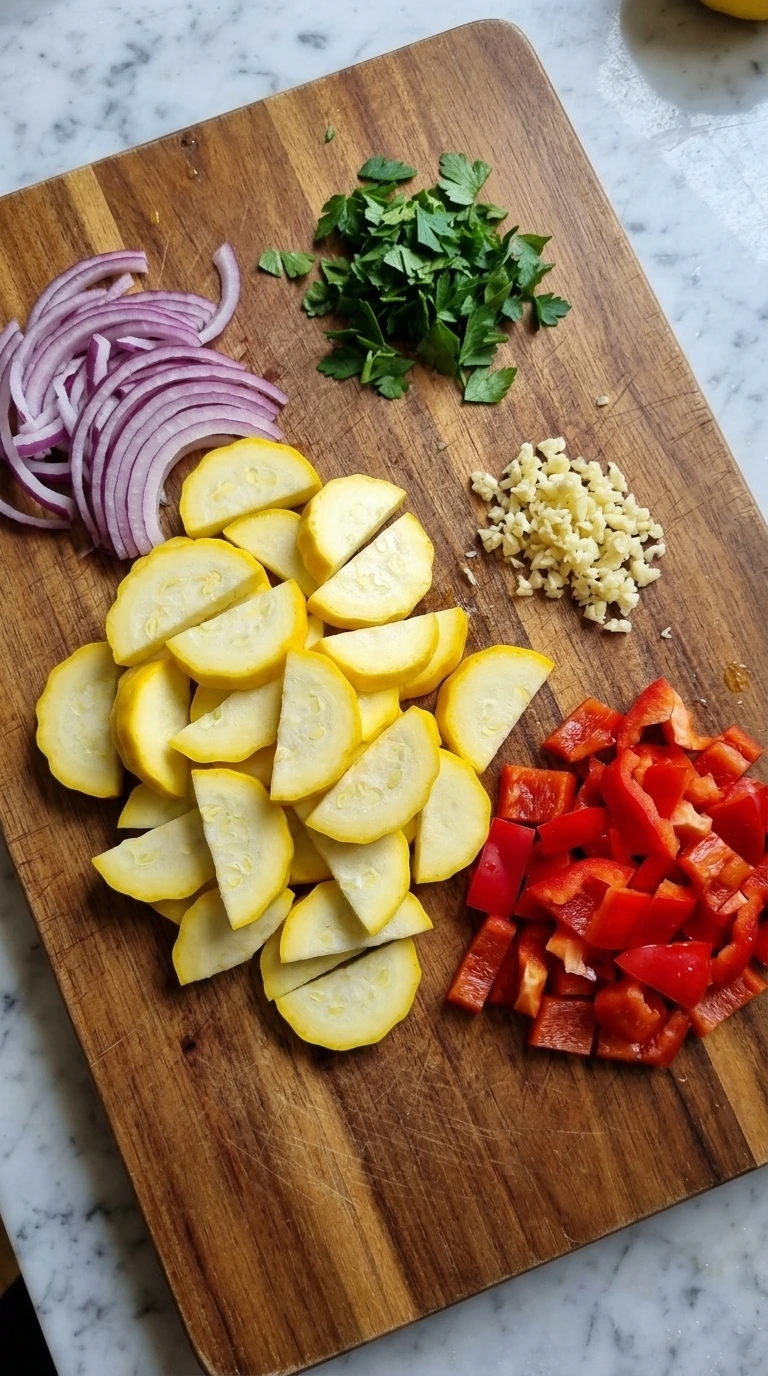
Keep the eggs and vegetables chilled at 40°F until you start. Then trim the patty pan squash and cut it into uneven 1/4-inch half-moons. Dice the red bell pepper into 1/2-inch pieces and thinly slice the red onion. Mince the garlic and chop the parsley.
Finish all cutting within 10 minutes so the vegetables stay crisp and dry. Next, spread the cut vegetables into separate loose piles and check their thickness. The squash should feel firm and show pale yellow centers with scalloped green-yellow edges. You’ll smell the onion only after slicing it.
Thick squash pieces stay hard while paper-thin pieces collapse. Consistent cuts let every vegetable soften within the same cooking window.
Tip: Choose patty pan squash under 4 inches wide because larger squash often has tougher skin and more developed seeds.
Step 2: Sauté the squash until lightly golden
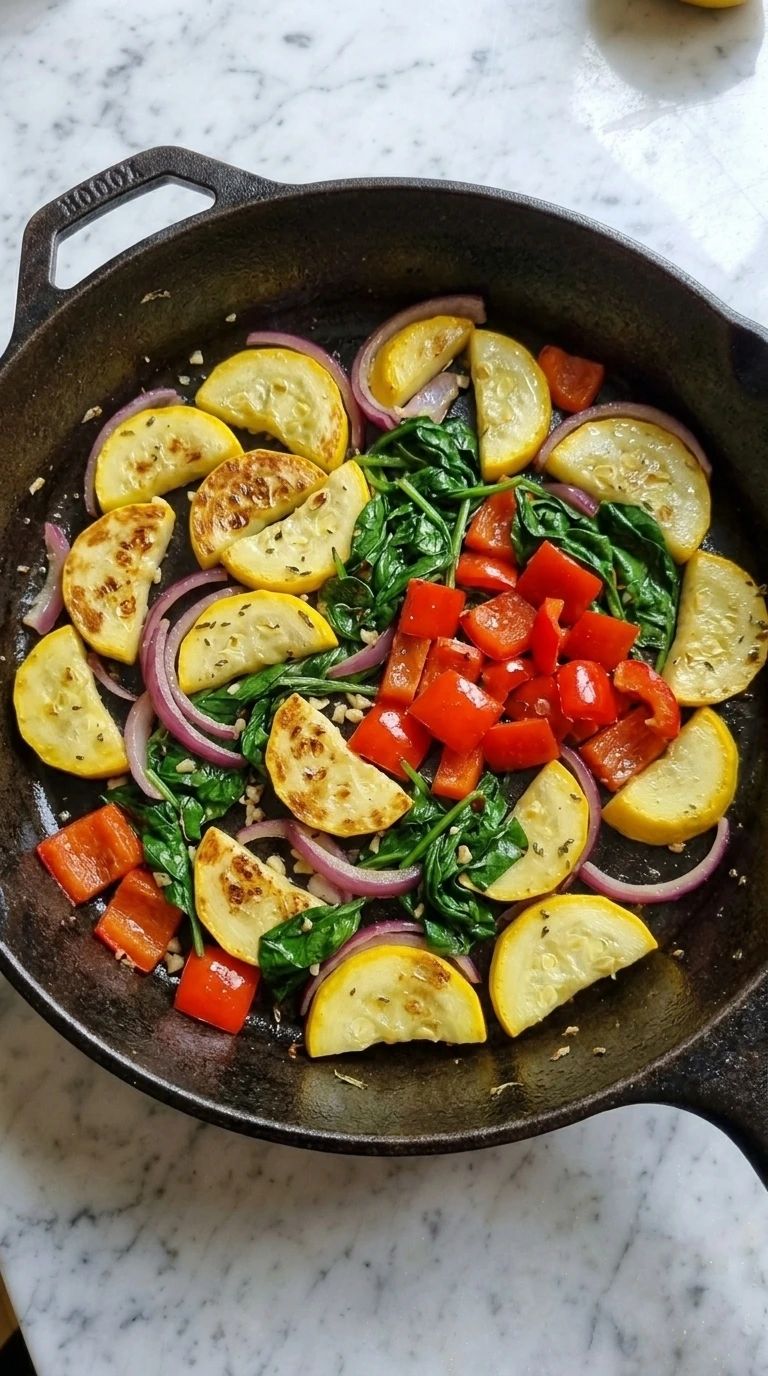
Heat the extra-virgin olive oil over medium-high heat at about 6 on a 10-dial. Add the squash, red bell pepper and red onion with half the salt. Cook for 7 to 9 minutes. Turn the pieces every 90 seconds and keep them in one loose layer.
Add the garlic, thyme and baby spinach during the final 60 seconds. Meanwhile, watch for bronze spots on the squash and softened red pepper edges. The onion turns glossy and the spinach shrinks into dark green folds. You’ll smell toasted thyme when the vegetables are ready.
Go past 9 minutes and the squash releases water into the eggs. Fast sautéing drives off moisture before the frittata sets.
Tip: Leave the vegetables untouched for the first 90 seconds so the squash develops color instead of steaming.
Step 3: Whisk the eggs with milk and cheddar

Let the eight large eggs sit for 10 minutes until they reach about 60°F. Crack them into a large clear glass mixing bowl. Add whole milk, remaining salt and ground black pepper. Whisk in tight circles for 45 seconds and scrape the sides halfway through.
Fold in three-quarters of the sharp cheddar with six broad strokes so some strands remain visible. Then look for a smooth golden mixture with small bubbles and uneven cheddar ribbons. The eggs should pour in one continuous stream but shouldn’t look foamy. Overwhisk for 2 minutes and the baked texture turns airy then rubbery.
(I once whisked until frothy, the center rose and collapsed. ) Short whisking blends proteins without trapping excessive air.
Tip: Grate the cheddar from a cold block through large holes because pre-shredded cheese melts less evenly.
Step 4: Pour the eggs over the vegetables
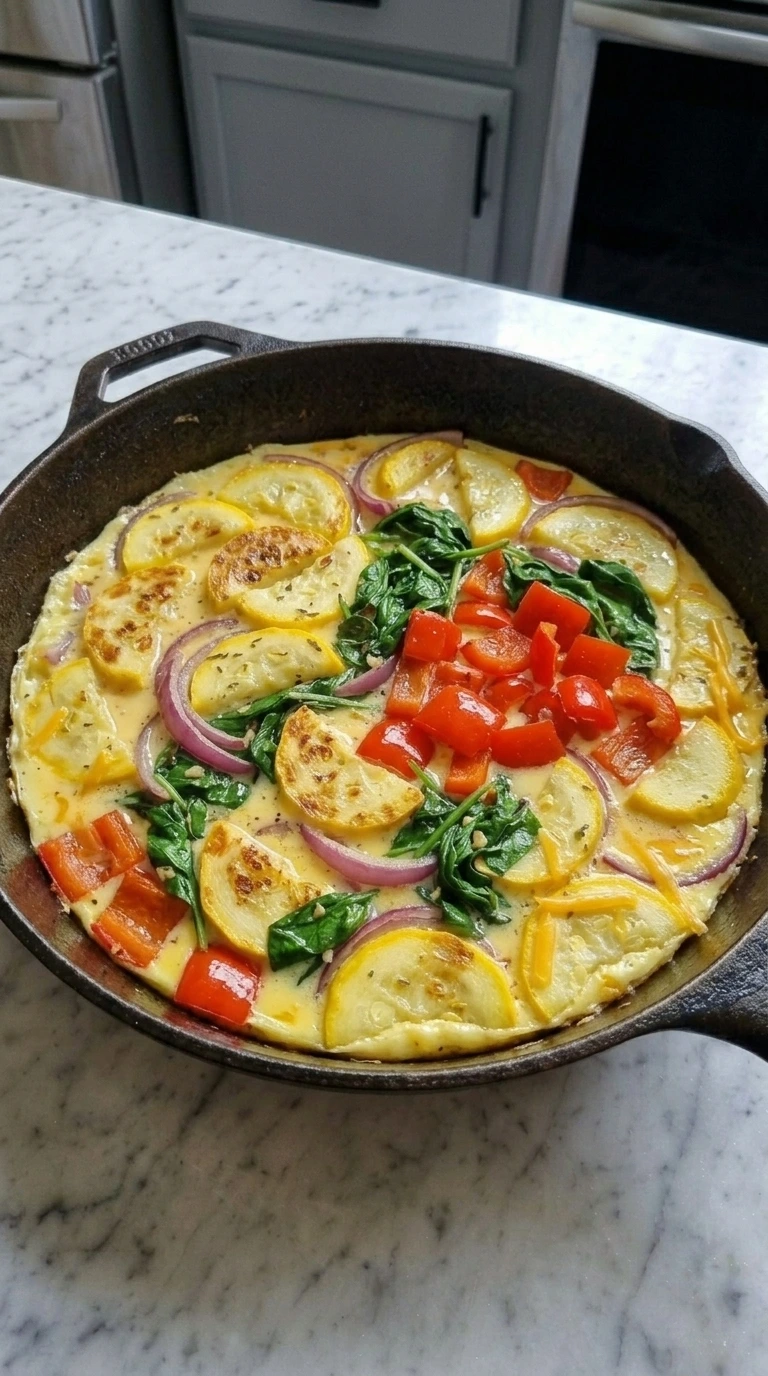
Reduce the skillet to medium-low heat at about 3 on a 10-dial. Redistribute the vegetables across the skillet and pour the egg mixture slowly from the center outward. Cook for 3 to 4 minutes without stirring. Lift two vegetable clusters once and let liquid egg flow underneath.
Scatter the remaining sharp cheddar across the top during the final minute. Next, watch the outer inch turn opaque while the center stays glossy and loose. Small bubbles should rise quietly around the squash. The cheddar begins softening but keeps its strands.
Cook past 4 minutes and the bottom toughens before the center reaches the oven. Gentle stovetop setting anchors the vegetables without overcooking the base.
Tip: Run a heatproof spatula around the edge once at minute 3 so the baked frittata releases cleanly later.
Step 5: Bake until the center is softly set

Transfer the skillet to a 375°F preheated oven and bake for 12 to 15 minutes. Rotate the skillet 180 degrees at minute 8. Check the center with an instant-read thermometer at minute 12. Remove it when the center reaches 160°F and only a slight two-inch wobble remains.
Food Safety and Inspection Service+1 Broil at 500°F for 60 seconds only when the top looks pale. Finally, the surface should look golden with deeper brown patches near the rim. The cheddar forms blistered spots and the squash edges stay visible. You’ll smell toasted cheese and thyme before the timer ends.
Go beyond 165°F and the eggs squeeze out moisture. (My 400°F batch browned early, 375°F fixed the wet center. ) Moderate heat sets the custard before the edges dry out.
Tip: Place the skillet on the oven’s middle rack so the base and top receive balanced heat.
Step 6: Rest, slice and garnish the frittata

Rest the frittata in the skillet for 8 minutes until the center falls near 145°F. Cut it into six uneven wedges with one firm downward motion per cut. Lift one wedge onto a white plate and scatter 2 tablespoons chopped flat-leaf parsley over the serving.
Keep the remaining wedges in the skillet so their moist interior stays protected. The plated wedge should hold its shape and reveal tender squash, red pepper and spinach through the yellow egg. The cut face looks moist but not wet.
The browned top stays slightly craggy and the cheese stretches only a little. Slice immediately and the center can tear or leak. Resting lets the egg proteins relax and hold clean slices.
Tip: Serve the wedge within 20 minutes because the browned top softens as steam settles.
Pro Tips
- Buy patty pan squash 2 to 4 inches wide because smaller squash has barely noticeable seeds and concentrated flavor. Better Homes & Gardens
- Cut squash into 1/4-inch half-moons so it softens within 9 minutes without losing its scalloped outline.
- Use a 10-inch skillet for eight eggs. A 12-inch skillet spreads the mixture too thin and shortens baking by several minutes.
- Stop whisking after 45 seconds when only small bubbles remain. Heavy foam creates a puffy top that collapses after baking.
- Check the center at minute 12 and remove the skillet at 160°F. Carryover heat raises it another 2 to 4 degrees.
- Broil for only 60 seconds at 500°F when the top lacks color. Longer broiling can scorch the exposed spinach.
- Rest the frittata for 8 minutes before cutting so the wedges hold together and the cut face stays moist.
- Add 4 ounces of cooked crumbled bacon and reduce the kosher salt to 1/2 teaspoon for a smoky breakfast version.
- Replace the red bell pepper with 1 cup halved cherry tomatoes and sauté them for 3 extra minutes to remove surface moisture.
- Use 3/4 cup crumbled feta instead of cheddar and add 1 teaspoon dried oregano for a sharper Mediterranean-style variation.
- Fold in 1 cup roasted corn kernels and 1 minced jalapeño for a late-summer version with sweet heat.
Storage Instructions
Cool leftover frittata within 2 hours and refrigerate it in a shallow airtight container for up to 4 days. Place parchment between wedges so the browned surfaces don’t stick together during storage. Freeze individual slices only after they cool fully to room temperature.
Wrap each slice tightly and seal it in a freezer bag for up to 2 full months. Reheat refrigerated wedges at 325°F for 10 to 12 minutes until the center reaches 165°F. FSIS A microwave also works at 50 percent power for 60 to 90 seconds.
Cold wedges pack well beside Creamy Pasta Salad for an easy lunch. Discard slices with a sour smell, slippery surface or separated liquid around the edges.
Print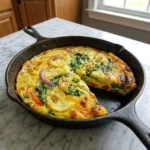
Patty Pan Squash Frittata
- Total Time: 45 minutes
- Yield: 6 servings 1x
Description
This Patty Pan Squash Frittata is an easy and healthy choice for brunch, meal prep or a quick weeknight dinner. Tender squash, red pepper and sharp cheddar bake into a simple egg base with golden edges and a soft center. The best part is the smell of thyme and toasted cheese as it bakes. What makes this version different is the skillet method. The trick is sautéing the squash first, so it stays flavorful instead of watering down the eggs. Keep it with best breakfast ideas.
Ingredients
- 4 small, about 2 cups Yellow patty pan squash
- 1 medium Red bell pepper
- 1/2 small Red onion
- 1 large clove Garlic
- 2 packed cups Baby spinach
- 1 teaspoon Fresh thyme leaves
- 2 tablespoons Flat-leaf parsley
- 8 large Large eggs
- 1/3 cup Whole milk
- 1 cup Sharp cheddar cheese
- 1 tablespoon Extra-virgin olive oil
- 3/4 teaspoon Kosher salt
- 1/4 teaspoon Ground black pepper
Instructions
- Keep the eggs and vegetables chilled at 40°F until you start. Then trim the patty pan squash and cut it into uneven 1/4-inch half-moons. Dice the red bell pepper into 1/2-inch pieces and thinly slice the red onion. Mince the garlic and chop the parsley. Finish all cutting within 10 minutes so the vegetables stay crisp and dry. Next, spread the cut vegetables into separate loose piles and check their thickness. The squash should feel firm and show pale yellow centers with scalloped green-yellow edges. You’ll smell the onion only after slicing it. Thick squash pieces stay hard while paper-thin pieces collapse. Consistent cuts let every vegetable soften within the same cooking window.
- Heat the extra-virgin olive oil over medium-high heat at about 6 on a 10-dial. Add the squash, red bell pepper and red onion with half the salt. Cook for 7 to 9 minutes. Turn the pieces every 90 seconds and keep them in one loose layer. Add the garlic, thyme and baby spinach during the final 60 seconds. Meanwhile, watch for bronze spots on the squash and softened red pepper edges. The onion turns glossy and the spinach shrinks into dark green folds. You’ll smell toasted thyme when the vegetables are ready. Go past 9 minutes and the squash releases water into the eggs. Fast sautéing drives off moisture before the frittata sets.
- Let the eight large eggs sit for 10 minutes until they reach about 60°F. Crack them into a large clear glass mixing bowl. Add whole milk, remaining salt and ground black pepper. Whisk in tight circles for 45 seconds and scrape the sides halfway through. Fold in three-quarters of the sharp cheddar with six broad strokes so some strands remain visible. Then look for a smooth golden mixture with small bubbles and uneven cheddar ribbons. The eggs should pour in one continuous stream but shouldn’t look foamy. Overwhisk for 2 minutes and the baked texture turns airy then rubbery. (I once whisked until frothy, the center rose and collapsed.) Short whisking blends proteins without trapping excessive air.
- Reduce the skillet to medium-low heat at about 3 on a 10-dial. Redistribute the vegetables across the skillet and pour the egg mixture slowly from the center outward. Cook for 3 to 4 minutes without stirring. Lift two vegetable clusters once and let liquid egg flow underneath. Scatter the remaining sharp cheddar across the top during the final minute. Next, watch the outer inch turn opaque while the center stays glossy and loose. Small bubbles should rise quietly around the squash. The cheddar begins softening but keeps its strands. Cook past 4 minutes and the bottom toughens before the center reaches the oven. Gentle stovetop setting anchors the vegetables without overcooking the base.
- Transfer the skillet to a 375°F preheated oven and bake for 12 to 15 minutes. Rotate the skillet 180 degrees at minute 8. Check the center with an instant-read thermometer at minute 12. Remove it when the center reaches 160°F and only a slight two-inch wobble remains. Food Safety and Inspection Service+1 Broil at 500°F for 60 seconds only when the top looks pale. Finally, the surface should look golden with deeper brown patches near the rim. The cheddar forms blistered spots and the squash edges stay visible. You’ll smell toasted cheese and thyme before the timer ends. Go beyond 165°F and the eggs squeeze out moisture. (My 400°F batch browned early, 375°F fixed the wet center.) Moderate heat sets the custard before the edges dry out.
- Rest the frittata in the skillet for 8 minutes until the center falls near 145°F. Cut it into six uneven wedges with one firm downward motion per cut. Lift one wedge onto a white plate and scatter 2 tablespoons chopped flat-leaf parsley over the serving. Keep the remaining wedges in the skillet so their moist interior stays protected. The plated wedge should hold its shape and reveal tender squash, red pepper and spinach through the yellow egg. The cut face looks moist but not wet. The browned top stays slightly craggy and the cheese stretches only a little. Slice immediately and the center can tear or leak. Resting lets the egg proteins relax and hold clean slices.
Notes
Pro Tips:
- Buy patty pan squash 2 to 4 inches wide because smaller squash has barely noticeable seeds and concentrated flavor. Better Homes & Gardens
- Cut squash into 1/4-inch half-moons so it softens within 9 minutes without losing its scalloped outline.
- Use a 10-inch skillet for eight eggs. A 12-inch skillet spreads the mixture too thin and shortens baking by several minutes.
- Stop whisking after 45 seconds when only small bubbles remain. Heavy foam creates a puffy top that collapses after baking.
- Check the center at minute 12 and remove the skillet at 160°F. Carryover heat raises it another 2 to 4 degrees.
- Broil for only 60 seconds at 500°F when the top lacks color. Longer broiling can scorch the exposed spinach.
- Rest the frittata for 8 minutes before cutting so the wedges hold together and the cut face stays moist.
Storage: Cool leftover frittata within 2 hours and refrigerate it in a shallow airtight container for up to 4 days. Place parchment between wedges so the browned surfaces don’t stick together during storage. Freeze individual slices only after they cool fully to room temperature. Wrap each slice tightly and seal it in a freezer bag for up to 2 full months. Reheat refrigerated wedges at 325°F for 10 to 12 minutes until the center reaches 165°F. FSIS A microwave also works at 50 percent power for 60 to 90 seconds. Cold wedges pack well beside Creamy Pasta Salad for an easy lunch. Discard slices with a sour smell, slippery surface or separated liquid around the edges.
- Prep Time: 15 minutes
- Cook Time: 30 minutes
- Category: Breakfast
- Cuisine: American
Nutrition
- Serving Size: 1 serving (of 6)
- Calories: 262
- Sugar: 5g
- Sodium: 723mg
- Fat: 24g
- Carbohydrates: 11g
- Fiber: 3g
- Cholesterol: 293mg
Frequently Asked Questions
Yes. Slice the vegetables and grate the cheddar up to 24 hours ahead, then refrigerate them in separate airtight containers. Whisk the eggs only 30 minutes before cooking because a longer hold can thin the mixture and weaken the final set.
The squash probably released moisture after the eggs were added. Sauté the 1/4-inch slices for 7 to 9 minutes and wait for bronze spots before pouring. Also remove the frittata at 160°F because overcooked eggs can squeeze water onto the surface.
Replace whole milk with 1/3 cup unsweetened oat milk and use 1 cup dairy-free cheddar shreds. Bake until the center reaches 162°F because plant-based cheese can hide a loose center. Expect less browning and a slightly softer texture.
Double every ingredient and bake the mixture in a greased 9 by 13-inch ceramic dish. Sauté the vegetables in two batches so they brown rather than steam. Bake at 375°F for 24 to 30 minutes and confirm 160°F in the center.
Freeze fully cooled wedges individually for up to 2 months. Wrap each wedge tightly and place them in a freezer bag with the air pressed out. Reheat from frozen at 325°F for 18 to 22 minutes so the center warms without drying.
Serve one warm wedge with toast and fruit for a complete breakfast. For brunch, add a crisp salad and roasted potatoes while the frittata rests for 8 minutes. At dinner, a 2-cup green salad keeps the plate light and balanced without hiding the squash flavor.
Final Thoughts
If you try this recipe, I really hope you love it as much as my family does. It has become one of those dishes we keep coming back to because the squash stays tender and the center stays soft.
Drop a comment below and let me know how yours turned out. And if you’re looking for more easy breakfast ideas, make sure to bookmark this page.
I’m always adding simple recipes like Homemade Cinnamon Rolls and dinner favorites like Chicken Fajita Bowl.